Monday, September 16, 2013

Food for Thought: retrospective on A la mode frangourou

(This piece was first published in the writers' blog, Writer Unboxed, www.writerunboxed.com, and then in my collection of short pieces on writing, By the Book: Tips of the Trade for writers. I'm re-publishing it here as a bit of a retrospective on this blog.)

Food For Thought
In an idle moment a couple of years ago, when I was between novels and feeling at something of a loose end, I finally got around to doing something I'd been thinking about for a while: start my own blog on food and all sorts of culinary matters, with a French-Australian slant. I wanted it to be much more than a mere collection of recipes or restaurant reviews or anything like that. This was to be a space for memoir, for musings, for dipping into literary culinary classics, for showcasing the seasons in our very productive vegetable garden and orchard, for culinary travel, for giving tips, shortcuts, and yes, recipes, my own, my family's, and those I'd gleaned from all kinds of weird and wonderful sources. And so A la mode frangourou was born. 
Being from a French background, I imbibed with my mother's milk the notion that food was not only necessary to life, but an expression of culture, a sensual pleasure, and a real art. For centuries, great cooks and chefs have been ennobled by French kings and fêted by French society, and great writers have written about it, but it's not just an upper-class thing. The whole culture of food, from the growing of it to the preparation and partaking of meals is part of the glue that holds French society together. One of the reasons why French food is so good is that just about everyone cares, from rich to poor and in between, peasant to nobleman, factory worker to banker, people consider it a serious matter worthy of the highest respect. And the amazing regional diversity of the country makes for a gloriously diverse cuisine as well. But my other country is Australia, the country that has become my home, and though in the past Australian cuisine left a lot to be desired, today it's vibrant, exciting, imaginative and fresh. There's still a good long way to go as regards some things, especially the quality of vegetables available in supermarkets which in contrast to French supermarkets focus on size and unbruisability rather than taste. But thanks not only to the injection of immigrant cultures such as Greek, Italian, Lebanese and Asian, but also such programs as Master Chef and so on, Australians of all backgrounds have discovered the joys of good food in greater and greater numbers. And that's also spurred on a bigger and bigger interest in food writing as well, and now the shelves are groaning with cookbooks and musings on food, newspapers and magazines have regular columns on it, and of course there's been a huge proliferation of food blogs.
I'd written food pieces myself before I started the blog. In fact my very first professional published piece of work ever was on Basque cooking in the now-defunct Vogue Living magazine, published when I was 22. My mother's family is part Basque and many's the summer we'd spent in the Basque country, so my piece was part memoir, part travel, part recipes. After that whilst writing short stories and novels(most of which featured at least some descriptions of meals, much as I'd carefully noted down my childhood meals in my diary since I was little!) I also dashed off articles for newspapers on various aspects of French food, on markets, on regional cooking of all sorts, and I sold some of my own original recipes to women's magazines. So writing about it wasn't new to me, and it seemed a natural step to create the blog. And why 'a la mode frangourou'? Well, 'a la mode' can mean both 'in the style of' and 'fashionable' in French, and 'frangourou' (or 'frangaroo' if you're leaning more to English) is my own coined word for the hybrid I am, a mixture of French and Australian, evoking Australia's most well-known animal.
It's been a lot of fun, and a learning process too. One thing I learned was that you get a lot more traction from a food blog than any other kind I've ever created for myself(Writer Unboxed is different!) Though my blog doesn't have a lot of official 'followers', the stat counter I installed showed me that this is multiplied sometimes up to ten-fold or more when you're looking at the number of visitors to the site. And what's more, even though of course I'm writing the blog for free, within just a few months, thanks directly to the blog, I scored a dream gig: I was asked to be one of the paid reviewers for an annual restaurant guidebook published by one of Australia's biggest media organisations. Pretty cool!
I'd like to pass on a few tips here if you're thinking of creating your own food/cooking blog:
1/Have a definite and original focus. Of course this is so in all blogging, but it is especially so with a food blog. What is it about your cooking or outlook on food that really sets it apart from other people's? It doesn't have to be rooted in a cultural thing, like mine, but should be personally quirky in some way.
2/Range widely within your focus but don't get too distracted
3/Don't blog too often: once or twice a week is enough(I did heaps more at the beginning, but have now learned my lesson.) People need time to digest what you've written, as it were, and to try out your tips and recipes
4/Make sure your recipes work! I only ever write up ones I've tried myself and know are goers.
5/Think about the beauty of your words and images as well. Your food blog should be a feast for the eyes and ears and the imagination as well as the salivary glands!

Monday, September 9, 2013

Asparagus time

The winter's ended rather abruptly here in New England(NSW) and the weather's mild already, making the garden wake up from its brassica and root vegetable slumbers and think about producing spring vegetables. And here, springing out of the ground indeed, come the asparagus, a bit early in the season and all the more welcome for that!
I can never get enough of asparagus--such a fine flavour, so easy to cook and use. Whether hot and served with butter, or cold and served with vinaigrette, blended into soup or made into yummy quiches and pies(they go really well with seafood--smoked salmon and asparagus quiche or salmon and scallop pie being particularly good), they are always delightful. And straight out of the garden too, they are just bursting with flavour. here's one of the simplest and nicest way to eat them, as a delicious entree, with vinaigrette--I use a mix of extra virgin olive oil, white balsamic vinegar and Dijon mustard, shaken together. Not even any need for salt and pepper, as the mustard provides that edge.

Monday, September 2, 2013

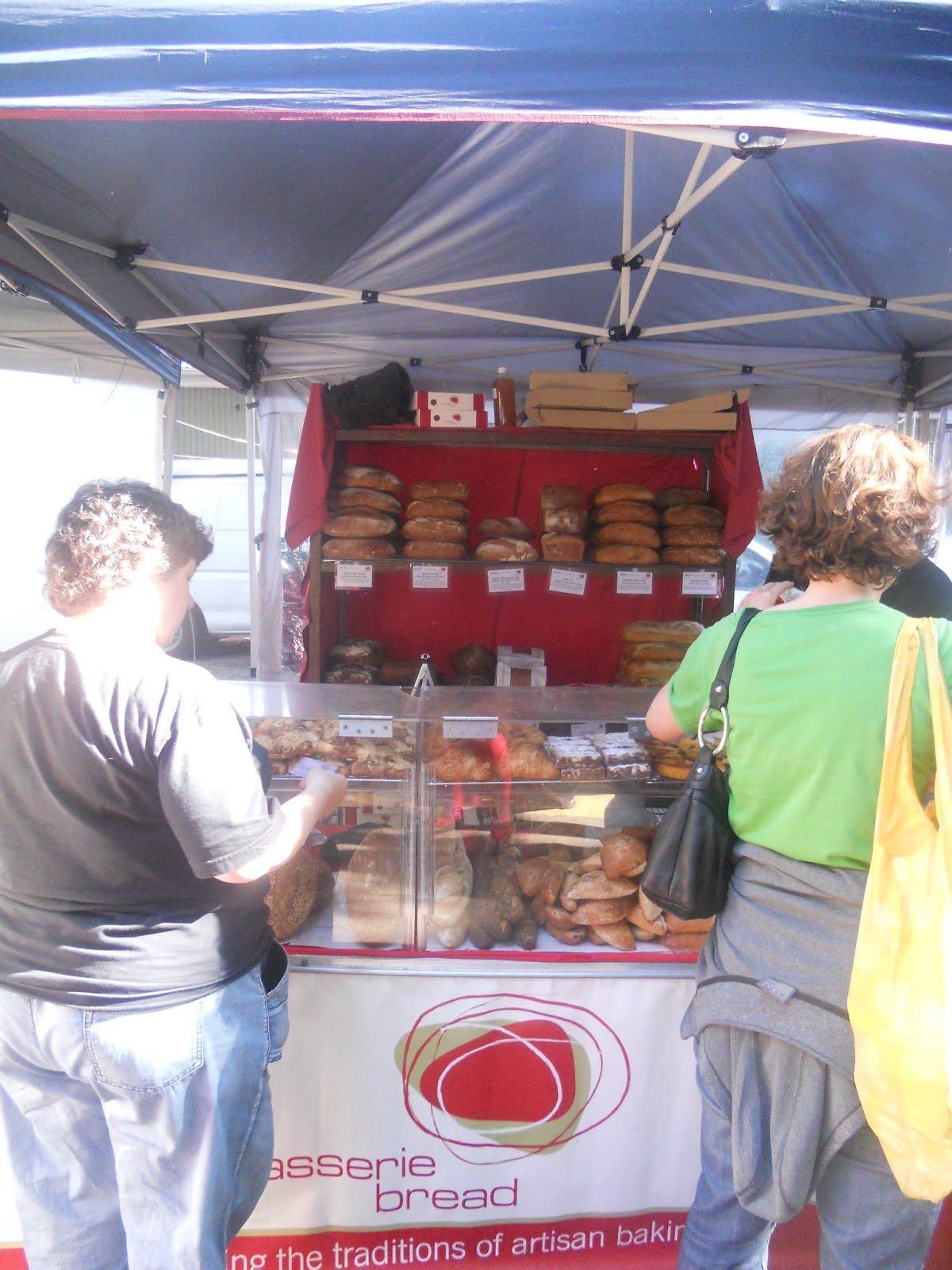
Marrickville markets, Sydney


Had a lovely morning exploring Marrickville Markets the other day--looking at, and tasting, and buying some lovely produce, including the fabulous charcuterie made by one French providore! Here are some photos from there.

Thursday, August 8, 2013

Soup series: our buttermilk and coriander soup

This soup is one we first learned to make when we were visiting Zimbabwe, many years ago, in the 80's. It is a delicious, quick and unusual soup that was a speciality of a friend of ours called Nathoo, whose heritage was part African, part Indian, and it was based around one of the local products, a fermented milk product called Lacto, which is pretty close to buttermilk or kefir, as well as on coriander., and a curry spice mix--made fresh or dried if you like(though fresh tastes much the best). Buttermilk is easy to find in the supermarket.
Very quick to whip up, fresh-tasting and irresistible, this soup is good in both the cold and warmer months.
For the spice paste: coriander seeds, two cardamon seeds, a little fresh chilli. First fry the ingredients quickly in a pan(only a few instants) then grind either in a mortar and pestle or a machine. Set aside. Chop a largish onion finely, fry, add crushed garlic, the spice mix, salt, chopped coriander leaves(reserve some for end for decoration), add a little stock of your choice--and then buttermilk--about half a cup of buttermilk to a cup of stock. Cook for only a couple of minutes, then serve, with reserved chopped coriander on top. Et voilà!

Thursday, July 25, 2013

Soup series, 10: Meredith Costain's pumpkin soup with Asian flavours


Years ago I worked near a café that made the most wonderful lunches. There was no set menu – just vats of whatever the chef felt like making that day. One of the regular offerings was a silky pumpkin soup with ‘Asian flavours’. I invented my own version of it. It must be okay, because every time I serve it to guests, they always ask me for the recipe

Ingredients:

• 1 large butternut pumpkin
• 1/2 kumara (orange sweet potato) or extra pumpkin
• 1 large onion, chopped
• 1 large very ripe tomato
• chicken or vegetable stock (Massel or Vegeta are good commercial brands)
• 1 tablespoon Red Thai curry paste (Mae Ploy brand is best)
• pinch cumin
• 1/2 tin coconut milk
• bunch of coriander

1 Peel the pumpkin and kumara and chop into chunks.
2 Place into a large stock pot with the chopped onion.
3 Add enough stock to cover the vegetables.
4 Bring to the boil. Turn down heat and stir in the Thai red curry paste.
5 Cut a cross in the top of the tomato and add to the stock for a couple of minutes. Remove tomato and peel off skin, chop roughly and return to the pot.
6 Simmer for 40 minutes or until vegetables are soft.
7 Blend soup till thick. (A stick blender is best for this as it can be done while the soup is still in the pot). If your soup looks too ‘watery’, reduce this by simmering until some of the liquid evaporates.
8 Add the coconut milk and cumin and put the pot back on the stove over a low heat for a few minutes.
9 Pour into bowls and garnish generously with coriander.

My latest picture book Daddies are Lovely is out next month from Koala Books/Scholastic, just in time for Father’s Day. With gorgeous pictures of dogs and puppies by Slovenian illustrator Polona Lovsin, it celebrates the special relationship between fathers and their children. Why not let your dad know how much you love him by making him a bowl of pumpkin soup!

Thursday, July 18, 2013

Soup series, 9: Gillian Polack's chicken soup and kneidlach(dumplings)


Chicken soup
There are many ways of making this soup. The very best involves a big boiling chicken, some giblets, some feet and the usual vegetables. I can’t get most of these things easily, so I’m giving you the recipe as I made it tonight. The quantities are large, but it freezes perfectly and is good to steam rice in (then I add coriander and chilli and other things and call it rice porridge) and somehow none goes to waste. Vegetables and meat can be eaten with the soup, or it can be eaten (as pictured) as a simple broth.
Ingredients:
2 kg chicken frames
1 big handful chicken giblets
1 big handful chicken necks
2 big onions (peeled but not chopped)
1 big parsnip (cut into half or quarters)
Celery tops (the leafier the celery the better)
3 carrots (halved)
Seasoning
Much water

Method:
Put the chicken in your biggest pot. Add enough water to cover. Bring this to a boil and simmer for at least 8 hours with the lid off the pot. If more water needs adding (this depends on the size of your pot) just add more. Make sure that nothing sticks to the bottom (stir from time to time). Let it sit overnight. Skim.
Reheat and add the onion. After an hour or so, add carrot and parsnip. After another hour, add celery and season. Let it cook until it’s satisfactorily golden and tasty, skimming or stirring as necessary and adding water as necessary.

Kneidlach (dumplings)
Ingredients:
2 medium eggs
2 tablespoons water
2 tablespoons oil or fat (preferably chicken fat rendered with onion, but olive oil is healthier)
Salt (to taste)
Pepper (to taste)
1 cup coarse matzah meal
Sometimes I add a bit of cinnamon, or some almond meal, or some finely chopped celery.
Method:
Mix liquid ingredients first. Add everything else and mix well. Let sit for 2 hours. Form into balls (walnut size).
Bring a big pot of salted water to the boil. Add balls (do not crowd the pot) and cook them for 20 minutes.

Thursday, July 11, 2013

Soup series, 8: Sue Bursztynski's favourite winter soup

I have a full time day job. Winter and summer alike, I'm up at six and out of the door soon after. My writing has to be fitted in around that, and all my books have been written and edited at night, sometimes till two in the morning, then up again for work at six. I don't have time or energy to do elaborate meals, not if I'm to get stuck into the writing after dinner. So my philosophy has always been to get the maximum result for the minimum of effort.

I don't have a lovely garden, only a balcony with unkillable green plants on it - my few efforts to grow herbs have been huge flops; because of this, I buy everything at a greengrocer or supermarket on the way home.

In the cold of winter, with the wind howling outside and the rain pouring down, I love to cook a thick soup to eat with hot buttered toast. Sometimes, if I'm out of bread, I make pan-fried flat bread, which takes about ten minutes and tastes wonderful.

This soup is one I created myself. It includes potatoes, onion, mushrooms and, believe it or not, spices. It's not a spicy soup, though - the spices are ground cumin, coriander and turmeric. Turmeric, especially, goes very well with potatoes, something I discovered by experiment. I don't cook with salt, but you're welcome to add it to your own taste and a little black pepper is also nice.

The recipe makes two bowls of soup, one for tonight, one for lunch at work next day, when it tastes even nicer than the first night.

Potato, Mushroom and Onion Soup

2 medium potatoes, peeled and chopped
1 large onion, finely chopped
Handful of mushrooms, chopped
Ground cumin, coriander and turmeric
500-750 ml boiling water

In a saucepan, fry a large finely chopped onion in a little olive oil. Add the mushrooms, then the potatoes. Throw in the spices and turn everything over so that it's well coated. Pour the boiling water from your kettle and stir. Leave to simmer till the potatoes are tender, then mash them and stir - this thickens the soup. Simmer some more till satisfied. It should take an hour or less from beginning till end, depending on how you like it, and while it simmers, you can prepare something else, check your email, write the latest chapter,etc.

Serve with hot buttered toast. Yum!

Sue Bursztynski is the author of numerous articles and short stories and ten children's and YA books, the most recent being Crime Time:Australians behaving badly(Ford Street Publishing) and Wolfborn (Woolshed Press, and imprint of Random House Australia). She is a member of the Andromeda Spaceways Inflight Magazine publishing collective, for which she is currently editing an issue.