Wednesday, May 30, 2012

Guest post: Belinda Murrell's unforgotten pearl of a cake


Sydney writer Belinda Murrell is the author of several thrilling adventure and fantasy novels for children, including The Sun Sword Trilogy, The Ivory Rose, The Ruby Talisman, and the Locket of Dreams. Belinda comes from a famous Australian literary family: her 19th century ancestor James Atkinson published his book on Australia in 1826, while his wife Charlotte wrote the first children's book ever to be published in Australia(1841). The family has been involved in things literary ever since, and Belinda's sister Kate Forsyth and brother Nick Humphrey are also best-selling authors. Belinda's new book, The Forgotten Pearl, is being released tomorrow, May 31, and to celebrate, I asked her if she'd write a guest post for A la mode frangourou. Enjoy!

 The Forgotten Pearl
by Belinda Murrell
Four years ago, my husband and I spent nearly two years travelling together with our three children having the most amazing adventures and experiences. This included five months in Europe (where I researched my books The Locket of Dreams and The Ruby Talisman), then about eighteen months travelling around Australia by 4WD. We spent several months in the exotic wilds of the Top End and I drew on these experiences while writing my new book, The Forgotten Pearl – the story of a teenage girl called Poppy and her experiences during World War 2. In 1941, Darwin is a remote outpost in the far north of Australia – a peaceful paradise far from the war. Poppy’s life seems perfect but when Japan attacks Pearl Harbour, then Australia, Poppy’s world is torn apart. Everything she holds dear is threatened – her family, her neighbours and her friends. The Forgotten Pearl is the story of Poppy’s own escape and her journey through love, grief, friendship and joy.
The book took months to research, and as the deadline to deliver it to my publisher loomed closer I became increasingly stressed and stretched. Like most mothers – as well as working, I am also a part-time school fund-raiser and volunteer/footy manager/chauffeur etc etc. The week before the book was due, I was also responsible for helping with my daughter’s fundraising cake stall including baking goods to sell. My beautiful sister-in-law Jenny Wall, came to my rescue and baked an enormous pile of cakes and biscuits for the stall. One of these was her wonderful Lemon Butter Cake which I happily bought and helped to consume, usually in the middle of the night while I was feverishly finishing the book.
Wonderful food and shared meals always feature strongly in my books – so it is probably little wonder that this lemon cake made a star appearance in the book. As my character Nanna says “This lemon cake is absolutely delicious… and is guaranteed to make anyone feel a whole lot better. Do you know that most of the troubles of the world can be solved with a cup of tea, a good chat and lemon cake?”
The Forgotten Pearl will be published on May 31.
Belinda’s website is www.belindamurrell.com.au 

Poppy’s Famous Lemon Cake recipe
Ingredients
Shortcake Base:
 2 cups self-raising flour, 1 cup caster sugar , 125 grams of butter softened, 2 eggs lightly beaten Lemon Butter: ½ cup lemon juice 1 cup sugar 2 eggs lightly beaten 125 grams of butter
Method
 Preheat oven to 160 C. Place lemon butter ingredients (juice, sugar, eggs and butter) in a small saucepan over low heat. Stir constantly to melt butter. Once mixture is liquid, continue to whisk over low heat until lemon butter boils and thickens slightly (approximately 10 minutes) then set aside. Place flour and sugar In a large mixing bowl. Add softened butter and rub into dry ingredients with your fingers until it resembles fine breadcrumbs. Make a well in the centre of the mix and add beaten eggs. Mix through to form stiff dough. Grease a round or square cake tin or line with baking paper. Press 2/3 of the dough mixture into the cake tin. Pour the hot lemon butter over the base then crumble the remaining dough over the lemon filling. Bake in the oven for about 45 minutes or until the cake is golden. If the oven is too hot, the lemon butter will burn. Allow the cake to cool in the tin. Dust the top of the cake with icing sugar. This cake can also be served with whipped cream and berries.
Bon Appétit!

Sunday, May 20, 2012

Tahitian fish delights


When I was a child, my father sometimes used to make what he called 'poisson Tahitien', or Tahitian fish, which basically was very fresh, very good, tasty white fish fillets,such as John Dory or bream or whatever, sliced thinly and marinated in lemon juice, salt and pepper, left in the fridge or other cool place for several hours and then eaten as was, for an entree or appetiser. We all loved it. At the time I'd never heard of sashimi or ceviche or other raw(ish) fish dishes common in other cultures, and nobody we knew in Sydney had ever heard of Tahitian fish either(I do believe though that it was inspired by an actual Tahitian method of preparing fish.) Indeed most people looked disgusted if you ever mentioned it--to such sceptics Dad maintained that the lemon juice 'cooked' the fish just as effectively as heat, and that he only ever used the freshest fish, but he didn't convince all that many people!
Now of course eating raw or raw-ish fish is widely accepted, as Australians have become used to such things in sampling Japanese or Mexican cuisine. I've become a fan of sashimi and ceviche myself, but I'm still very fond of Tahitian fish though these days I experiment with several different variations of it, using different sorts of fish as well, and not just the basics of white-fleshed fish and lemon juice. But I always follow the cardinal rule, drilled into us by our father: always choose the freshest fish, keep it in the cool, preferably in the fridge, and though you should let it marinate for a few hours, never let it stay for more than 24 hours uneaten. Despite having eaten quantities of Tahitian fish over the years, I have never ever had even the slightest queasy twinge from it--in fact the only times I've ever been ill with seafood or fish, it's been with conventionally cooked dishes(and in fact only in restaurants.).
I've varied the marinating liquid--lemon, lime, even orange juice, vinegars of different types--red wine vinegar for instance, makes a wonderful marinade for Atlantic salmon--and varied the fish too, from dory and snapper to tuna and salmon and trout, and added various seasonings as well as salt and pepper--herbs of all sorts and chilli, for instance, but also more exotic things still. And I also often add a touch of olive oil, especially to fish such as tuna.
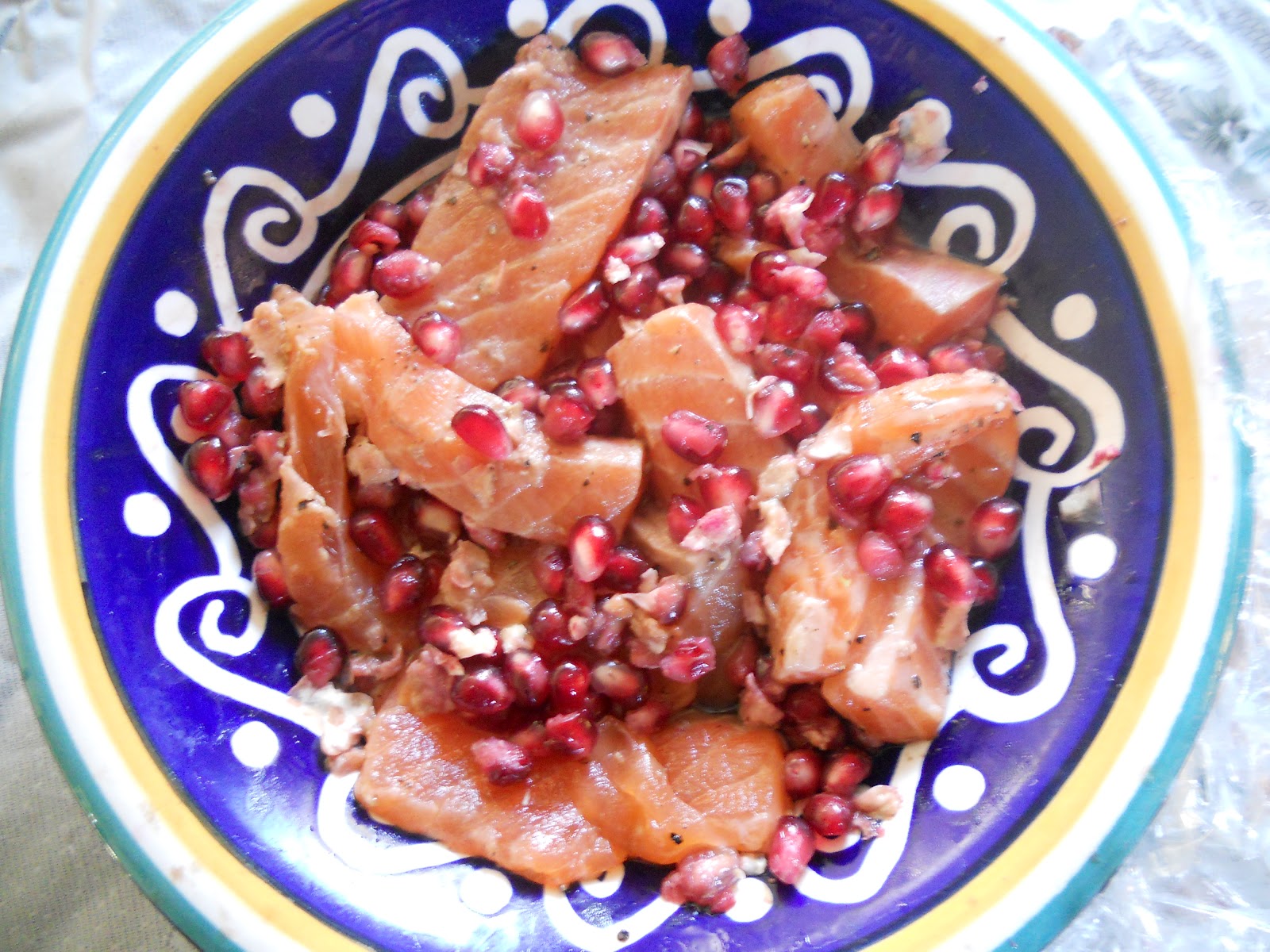
The other day, I made two varieties of Tahitian fish the other day for a family get-together: a tuna one and a salmon one. For the Tahitian tuna, after slicing the tuna, I marinaded it in lime juice, coriander, ginger, and salt and pepper, with a little olive oil added(Quantities depend on how much fish you have, it needs to be covered but not drowning in it.). For the Tahitian salmon, I used balsamic vinegar and pomegranate juice and seeds, with a little salt added: salmon and trout are both delicious with slightly sweetish but tangy marinades, and the combination of the balsamic vinegar and the pomegranate makes the perfect mixture. Both of them were very popular indeed!

Wednesday, May 9, 2012

Salsify and carbonnade

One of my favourite root vegetables is the salsify. With its delicious melt-in-the-mouth texture and subtle flavour, in France it's very common indeed and easily obtainable in any market. But in Australia it's very hard to find though in truth it grows wild in many places. Wild salsify isn't much good, though; the root, which is what you eat, is too thin and spindly and by the time you've peeled the unpalatable skin off, you don't have much flesh left. David searched for ages for domesticated salsify seed and finally tracked some down; and though the first year nothing much happened, somehow this year it's taken off. Our salsify isn't as big as the ones you get in France, but they are much bigger than the wild variety, and they've made some wonderful entrees(as in the photo) and vegetable side dishes.They can of course also proudly take their place on a vegetarian table, either as side dish to, say, Puty lentils, or as an unusual centrepiece in themselves.
To prepare salsify,  have a bowl or pan of cold water ready with a dash of vinegar in it. Cut off the tops, peel the roots and as you go, drop each peeled root into the vinegared water(if you don't do this, the roots will discolour). Then cut them into pieces as required, and cook: stir them first in a little melted butter, add salt, pepper, and just enough water to cover--though a touch of wine and stock mixed is even nicer. Cook till a knife goes through them easily. Drain, serve with a little butter and herbs. You can add sliced garlic too if you like though it might overwhelm the salsify's delicate flavour. In the entree dish of salsify in the photo, David added some chopped smoked salmon to it, which made a lovely contrast. As a side dish, salsify is yummy with all kinds of meats, but especially poultry and pork.
Such as the pork carbonnade also illustrated, which I made the other day. This very typical Gascon dish uses pork and prunes to create a lovely marriage of flavours. And it's dead simple to prepare. Fry the pork chops first till they're well-seared(but not thoroughly cooked), add salt, pepper, a touch of Armagnac(preferably) or cognac or brandy if you don't have Armagnac. Take the chops out of the pan, lay in a baking dish. Fry some chopped onions in the same juices as the pork. Pour cooked onions and juices over the meat. Add chopped prunes(without stones of course), sprinkle on top. Sprinkle with a little olive oil, another small splash of Armagnac/brandy. Bake in oven for about 20 minutes or until pork is well-cooked and prunes have almost melted together in a kind of soft mash. Serve with salsify or with garlicky potatoes cooked in duck fat, and a green salad.

Tuesday, May 1, 2012

An unusual twist to an old favourite


Pumpkin soup has got to be one of the classic cold-weather warmers. With its cheerful colour, cosily thick texture and distinctive taste, it's one of those dishes that turns up frequently on our autumn and winter table, especially when, as in this year, the garden is full of pumpkins. And they're all self-sown too, a prolific explosion of hybrid fertility, combining last year's Golden Nugget and Queensland Blue genes to create a pumpkin that's half way in size between the small Nuggets and the big Blues, with the Nugget's beautiful deep orange colour and the Blue's striated shape, making them look rather like the kind of thing Cinderella's fairy godmother touched with her magic wand.
It's a humbler kind of magic, turning them into soup, but more reliable, no midnight disappearance for that! (Unless of course someone gets up in the middle of the night feeling peckish..) And though we've made pumpkin soup hundreds of times in many different permutations and different ingredients, this is the first year we've hit on a new way of cooking it. And it was born out of frustration, for as well as the Blue's nice shape, this hybrid of ours has inherited the Blue's hatchet-blunting tough skin.
So what did we do? Instead of blunting knives and hatchets whilst also cutting fingers, or throwing the pumpkin on the floor to smash it into segments(as we've done before on occasion!)we cut off a bit from the top of the pumpkin(around the stalk), scooped out all the seeds, baked the pumpkin, covered in aluminium foil, in the oven for about 25-30 minutes, took it out again and then filled the central hole with chopped onions, garlic, herbs and chicken stock, then put it back in the oven to bake for a further 15-20 minutes or so. By this time all the flesh inside will have cooked,and you can either swirl it in with the stock etc to combine and serve as is, or, as we prefer to do, to tip out the liquid into a saucepan, and then add all the scooped-out flesh, mash a little, swirl to mix, add a little extra if you like: a little fresh chilli, or sour cream, or extra herbs or garlic, and then serve!
This method of cooking intensifies the flavour of the soup and really brings out the full colour of the pumpkin. And it's so much easier than trying to get the better of that pumpkin armour!

Thursday, April 26, 2012

Pharmacy in a Bowl, from Love and Hunger


There are 75 recipes in Charlotte Wood's book, Love and Hunger. Today, she shares a delicious seasonal warmer with readers of A la mode frangourou.   


Seeing as we’re heading into cold weather, I‘m offering this big pot of simple lentil soup. I first made it once when I had a horrible head cold and became convinced it cured me – hence the name.

Pharmacy in a Bowl    

Olive oil •       5 cloves garlic, finely chopped •       1 brown onion, finely chopped •       2 small red chillies, finely chopped •       1 stick celery, finely chopped •       1 leek, finely chopped •       ¼ white cabbage, finely chopped •       1 red capsicum, roughly chopped •       3 carrots, roughly chopped •       3 litres chicken stock •       1 head broccoli, roughly chopped •       1 x 400g can tomatoes in juice •       1 cup Puy lentils (also known as ‘French-style’ or ‘blue’ lentils) •       Salt and pepper •       Parmesan cheese, grated .  

 1. Sauté the garlic, onion, chilli, celery, leek, cabbage, capsicum and carrots in batches in the oil until well browned.
 2.      Put the chicken stock in a big pot on the stove and bring to the boil, tossing in all the sautéed ingredients. Add broccoli and tomatoes, and simmer until all vegetables are tender.
 4.      Reserving stock, remove vegetables with a slotted spoon and puree in a food processor or blender until smooth (or roughly blended, depending on how rustic you like your texture).
5.      Return pureed vegetables to stock and add lentils. Simmer for about 15 – 20 minutes or until lentils are tender (more if you want them falling apart). Season well with salt and pepper.
 6.      Serve with a sprinkle of Parmesan.
(Vegetarian option: replace chicken with vegetable stock)

Wednesday, April 25, 2012

Love and Hunger: an interview with Charlotte Wood


Sydney author Charlotte Wood's novels have garnered many awards, with her latest, Animal People (2011) longlisted for the Miles Franklin, and her 2007 novel The Children shortlisted for the Australian Book Industry Association’s literary fiction book of the year. Her earlier novel, The Submerged Cathedral, was shortlisted for the Miles Franklin Award and the Commonwealth Writers’ Prize in its region in 2005, while her first book, Pieces of a Girl, was also shortlisted for several prizes. Praised as stylish, acute, intelligent and compassionate, her books have been popular with critics and readers alike. Charlotte is also the editor of the short fiction collection Brothers & Sisters (2009) which featured 12 of Australia's finest writers exploring sibling relationships.
Today I'm speaking with Charlotte about her forthcoming book, which is quite different to the others. Love and Hunger, released on April 30, is a non-fiction meditation on food and cooking and its emotional and symbolical resonances. It also includes some great recipes, one of which Charlotte is kindly sharing with readers of A la mode frangourou.
 Charlotte's author website is at http://www.charlottewood.com.au/index.html 
There is also a separate website for Love and Hunger,  http://www.loveandhunger.com/
I'm publishing this interview in two parts, with the recipe to follow in a separate post. Enjoy!

SM: This is a very different kind of book about food, isn't it? How did it come about? 

CW: I had been writing a cooking blog for a few years (I started when our house was being renovated and all the disruption meant I couldn't work for concentrated periods on my novel) and found that I loved writing short, conversational pieces about what cooking means to me. The pieces often began with some little conundrum I'd had in the kitchen, or a fear of some technique or recipe or other (like making pastry – I had always been terrified of it), but also quite often broadened out into observations on more philosophical, abstract ideas about cooking and how it connects me to society and my place in the world. And I wanted to share recipes and have others share with me, naturally! When I finished my last novel Animal People I had an idea for a book that was purely practical - about how and what to cook for a friend in physical or emotional distress - but the publisher suggested something broader and more personal, which was a much better idea. And so we've ended up with a very personal book of pieces about how I learned to cook, why I love it, how it enriches my life, its connections to my literary work and the people in my life and so on. I am so glad I've written it. It's my first - and possibly only - book of non-fiction, but oddly for something so personal I found a great freedom in exploring and articulating what it is about cooking that I find so enriching.

 SM: From the Commonsense Cookery book to the proliferation of cookbooks we now see in the shops in Australia, it's been quite a jump. Why do you think cooking--writing about it, showing it on TV, talking about it -- has become such a big thing in this country? Do you think the public face of cooking undermines its private sphere or enriches it?

CW: Such a good question. I have a bit in the book, funnily enough, about how I hated the Commonsense Cookery Book and my school 'home economics' classes. It seemed to all be about deprivation and blandness and a correctly ironed apron than anything at all to do with pleasure or creativity, which of course is now what I am so in love with about cooking.  In terms of the proliferation of cooking shows and books and whatnot, who knows why it’s become so big. My first instinct is to say it’s a sign of greater affluence, but I don’t know if that’s right. I hope our growing concern about the damage we’ve done to the planet has something to do with it. Food production has such a serious effect on the environment, from the way it’s grown to the way food waste is disposed of, that it’s crucial we pay attention to it – hence the rise of organic and free range food and farmer’s markets and so on. Then there’s the competitive element of MasterChef and Iron Chef and so on, which is hugely entertaining.  I think anything that connects us more to where our food comes from and makes it easier and more pleasurable and fun to cook good food is to be welcomed. And anything that frames cooking as competitive, stressful, elite or expensive or difficult should be thoroughly challenged. I am as addicted to MasterChef as the next person - but I don't think it represents what home cooking is about. It is great entertainment, which as we fiction writers know requires drama and conflict and pressure. That's not what cooking at home has to involve. I love the entertainment, but I don't think performance anxiety is a good way to inspire anyone to cook. And I do worry about home cooking being elevated to a level of complexity and technical skill that used only to be found in restaurants, because I think it can set people up to fail.  On the other hand, people like Maggie Beer and Jamie Oliver, who have a kind of egalitarian, friendly-teacher ethos and infectious enthusiasm for making cooking easy and pleasurable - I bow down to them. I love them.  I guess my guiding ethos about cooking is that it should be easy and pleasurable.  Some people – like me - find that a perfectly boiled egg gives them that feeling of accomplishment and ease and others like to make chocolate soil or confit-gold-leaf blahdyblah, and good luck to them. It only bothers me when I see people trying too hard to impress, getting stressed out and resentful and feeling like a failure for not being able to reproduce a three-hatted restaurant dish in a domestic kitchen on a Friday night. That way madness lies.
  
SM: Coming from a French background, I've always been immersed in an atmosphere where food and cooking meals are traditionally an important part of culture itself, and it seems like that's certainly beginning to happen in Australia. But how deep do you think it's gone here? And in what way do you think it will develop? For example, will we start to see regional cooking styles, do you think?

CW:I doubt we will ever catch up to the French! What I love about France and Italy and China and other countries with such strong food cultures is that cooking seems so natural, to everyone from every class of society - food is, as you say, so deeply embedded in the culture that it has nothing to do with privilege or education in a formal sense. It's in the soil and the blood and the sap of the country and the people, whereas we are just starting to develop a naturalness with food now, I think.  I also can't see us developing regional cuisines comparable to those of the French or Italians, but I think this is a sign of our openness as a culture, and I like that. An Italian friend of mine once told me she had never eaten pesto (she was about 30) because "it's not from my region" - I nearly keeled over with horror. I can appreciate and absolutely respect the fact that regional cooking in Europe has maintained itself through a strict adherence to singular cultural traditions, and obviously that's why it's so strong. But we are too magpie-like here to do that - the history of Australia is all about absorption of new cultures into existing ones, blending and melding - and of course we're also too modern, have too much access to travel and so on to maintain any strict regional delineations about food.  That said, the vastness of the country and the different climates and seasons do obviously create their own physical regions. And I think now we're starting to respect an earthier natural relationship between us and our food - to do with seasons, and local produce and so on - so personally I hope that will continue to guide a regional relationship to food that comes from the earth.   

SM: Many of us get our interest in food from family--was that your case?

CW: Not really - I discuss quite a lot in the book how my mum was not a great lover of cooking. She was incredibly selfless and diligent and very proficient at feeding seven people every single day with food she made herself - we never ate much processed or packaged food, so she was really committed to nutritious and healthy, often home-grown food. But her love was the garden - the kitchen was duty, and she did it with great good humour, but it was love of her family rather than love of cooking that drove her. My older sister taught herself to cook quite early and did teach me a great deal about cooking – but it wasn’t until I went to university in my twenties, had time on my hands and people around me who cooked, that I began to fall in love with it. These days my brother and sisters and I and all their families spend lots of time around dinner tables together, and the food is always good.  We're all greedy and love to eat - that helps provoke good cooking!

SM:  How would you characterise your own style of cooking?

CW: Casual, fresh, simple, big-plates-in-the-middle-of-the-table, Mediterraneanish with the odd Asian flirtation, noisy, messy, confident and - I hope - generous. 

SM: You've blogged about food for the last 3 years at http://howtoshuckanoyster.com/ What's your experience there been like?

 CW: I love it. Love it. I have made real friends from my blog friends, I have learned a huge amount from my readers. I have a loyal following of funny, astute, delightful home cooks who are as clever with words as they are generous with their knowledge. They have taught me more than they've ever learned from my blog, I assure you. I love the enormous freedom of blogging - that I can talk about complex philosophical questions one day and then just brag about my husband's poached eggs the next, or ask a question about something that's bothered me, or just share a brilliant scene from a novel that uses food to show so much more about what's going on between people than they understand. I love the democracy and the freedom of the internet for this kind of writing.

Tuesday, April 10, 2012

Theon's Oysters: Gallo-Romans in the Médoc


As a writer I've always much enjoyed filling the 'gaps in the historical record'. This short story I wrote some time ago is very much in that vein. It's based on the (real) letters of Ausonius of Bordeaux, a Gallo-Roman consul from the late 4th century--and a real character!-- to his friend Theon, who lived on the coast not far from Bordeaux, maybe near the present Arcachon which to this day is famous throughout France for its oysters. As Theon's replies aren't preserved, I 'discovered' them myself! (Incidentally, Ausonius is still famous in the Bordeaux region, and a great vineyard, Chateau d'Ausone in the Saint-Emilion terroir, is named after him.)


Theon's Oysters: Or, Town and Country

by Sophie Masson


Médoc, Gaul, about AD 390

Ausonius sends his greetings to rustic Theon, in the Médoc.
What are you doing, you who live at the very ends of the earth, you the ploughman of the poetic sands, who must labour without cease on the windy strand, between the Ocean and the setting sun, you who is now obliged to live in a poor peasant's hut, filled with black smoke that hurts your eyes? So, where then are the Muses and Apollo, oh my songster? Where are my verses?

What am I doing, Ausonius? Do you really want to know, my dear, vain old friend? Or would you prefer to hear only the sound of your own voice, as it is carried to me here at the ends of the earth? Ah, I can hear it clearly, Ausonius, just as in the days when we both worked for Emperor Gratian.
But I will tell you anyway, old friend, even if I do not know if you will listen. You ask what I am doing, what I could possibly be doing, in my Médoc, my remote between-two-waters, and you reproach me for not having sent you some of my verses, which I had, apparently, almost promised you.
You are perplexed: what could I be doing? Ah, they are not the poetic sands I plough every day, Ausonius, but the furrows of the waters..It is not the fantastic grain of the Muses which I harvest, but strange little beasts of salt and fresh water: oysters. It is neither Apollo nor the Muses whom I meet on that windy strand, but other poor souls like me, who like me are contented with huts filled with black smoke that hurts your eyes.
You ask what I could be doing, in my godforsaken land. You ask me, with a fine note of teasing, to send you some of my verses, all shiny and new. But..How to explain, Ausonius? Here, where Ocean and River meet in a soft and savage embrace, Court poetry has deserted me. The water, the oysters, the few brief salutations I exchange with my neighbours, these are my life, now, great Ausonius. You who have had everything, like me, you who, unlike me, was able to hold on to everything, how could you understand what I am doing here?
Far from Rome, far from my memories, here, in this strange empty country of wind and water, something strange has happened to me, Ausonius. I am living. And I understand things I never knew before. Politics and war, love and disillusion, mystery and terror, I have found them here too, here in my oyster-country. And more, much more, I see here things I never saw before in Rome, or even in your beloved Bordeaux: the small things of the rustic world. Only now I see they are not small things, but big ones.
I look at the sun setting on the waves of Ocean; and I blush at the thought that I once imagined I could capture it in a cage of elegant and well-turned verse. I watch a young couple walking on the strand, gathering weed and driftwood; benighted rustics I would have thought, once, and yet I see them touch each other's hand, briefly, tenderly, at the edge of Ocean. And the breath catches in my throat at the thought I imagined I knew what love was. I look at my oysters, washed sometimes by the sweet water, sometimes by the salt, and I groan at the thought that never, in any verse I had written, had I come even a small distance towards describing their briny and subtle tang, which is the very smell, the very presence, of Ocean himself.
And so, instead of sending you verses, I am sending you oysters. Thirty oysters, from the rustic country of Theon who lives between-two-waters.

Ausonius to Theon, who sent him thirty oysters.
I was waiting for a reply from you to the letter I had sent you, dear friend, asking you why you had so neglected me, and here I receive something from you I never asked for. So in reply I am sending you this letter, enamelled most colourfully, as I hope you will agree, with pleasing words on the subject of mussels and oysters! Ah, now then, mussels, if only you'd sent those..
But enough of regrets. Here is the sum of the oysters you sent me, Theon: three times ten, or five times six, or two times five plus ten and ten, or four times six added to twice times three; or seven times four plus one and one, or..

Stop, stop! All those numbers, all those mind games, they make my poor rustic head ache, Ausonius! I do beg pardon of you for not having sent you your preferred meal of mussels; but round here, you know, the mussels are kept for the poor souls only, not for the great ones of the world..and you, Ausonius, you had the ear of the late and lamented Emperor Gratian and I did not want to insult you..Such is how far I have fallen from a knowledge of the world!
Do you know what your poor mussel-eating servant, your oysterer Theon, did this very evening? A big fish, named whale, beached itself on our strand. If only you had seen it, Ausonius! What drama you would have breathed! Monster of the depths, poor child of Ocean, abandoned by a cruel parents to its fate, the whale struggled and thrashed around, for it did not want to die. For who amongst us who has breath wants to die? But the other inhabitants of between-two-waters and I, we took knives and axes, and we killed it, there on the sand. A red river flowed into Ocean this evening, and for a good long moment, the poetic sand blushed scarlet with escaping life. it is a good meat, whale-flesh, Ausonius, and my poor hut--filled with that acrid smoke--is full of it at present.
But if you had seen its dying glance! A sorrowful light, a speaking silence, which fades away, wordless, in the eye all at once clouded. Do you think the beasts and the fish and the birds have a soul, my Ausonius? If so, are they not children of God, born before us, and is it not a sin, what we do to them? But if not, then why does one see that sorrowful light, and hear that speaking silence?
Be quiet, Theon, you must be saying. You are saying foolish things. A whale does not have an immortal soul, any more than an oyster does. Ah, but then, Ausonius, oysters, my humble oysters of the Médoc, you have made a legend of them. Not only with your sums. For you have transformed them into figures of poetry; into slivers of Moon, and celestial piglets nestling at the teats of the stream that runs into Ocean, and have made them immortal, now, and they have slipped into the halls of the gods, in the briny modesty you gilded so well..

I, Ausonius, am sending greetings to my dear friend Theon, whilst still bearing reproach.
Three times now has Luna changed her stamping, snorting team of heifers as she careers in her cart across the sky; three months, Theon, and you haven't visited me. Are you avoiding my house, my land? Ninety days without you, dear friend, ninety days have I been sorrowful that is so, and what was more, these were summer days, and thus even longer. A quarter of the year has already passed. Come on, surely your little hut is not so welcoming and cosy that you cannot separate yourself from it! I want to see you and talk with you, my friend. And if it is money that prevents you from coming--well then, I am rich, as you are poor, and can help a friend along..

You want me to come and visit you again in Bordeaux, great capital of the waters, your native city, where you know everyone, where everyone knows you. Can you see the picture? And it's Yes, Monsieur the Consul, and No, Honourable Ausonius, and oh..oh, who can that poor soul be who walks with you? Ah, really, Theon the philosopher, the poet! I would never have recognised him! Oh, Monsieur the Honourable Consul Ausonius, how overflowing is your generous bounty and how deep your friendship towards even those who are disgraced..
Ah, I hear you protest, that is not so, Theon, I simply want to walk arm in arm with you in Bordeaux, old friends, though one is rich, and one is poor. You want, above all, Ausonius, dear Ausonius, that my bard's gift should return, my inspiration come back, springing like crystal out of the fertile rock of the society of men, just like the crystalline fountain of Divona, matron goddess of your beloved city, springs out of the ancient rock. But you see, Ausonius, if you really care for me, and not only for dead memories of things we once shared, and verses that are best forgotten, then you would come here, where I live, and you would see. My dear Ausonius, life is an oyster that may well contain a pearl--but if you never open the shell, how will you ever know? Come, then, my dear, vain old friend, my pearl amongst pontificators, and come and see me here, at the ends of the earth. In expectation, I send you these few modest gifts from my orchard, with my greetings.
What is a friend if not to share?
What is a friend if not to dare?
Rather silence than friendship's wreck:
What river the droplet will reject?

Ausonius, Consul, returns his salutations to the poet Theon.
Ah, golden apples you send me, Theon, but in a basket with leaden verse! Quinces bittersweet may make one wince; but it is not for the quince's wince that I weep, Theon.
Goodbye, Theon, whose name means of the gods--but as a participle, means, rather, a running man, a fleeing man!

Yes, I run, I flee, my vain old friend: not from what once was, but towards my oysters. At least they do not criticise my bad verse, or even my good one.
Goodbye, Ausonius, whose name means 'an Italian'; and make of that, my friend, whatever you may will.