A delicious summer entree, with a barramundi ceviche of my own invention, and fresh young summer vegetables.
The ceviche is made ahead of time--at least 6 hours, or even overnight.
For up to 4 people, you need: one medium-size fillet barramundi, half a cup red wine vinegar, salt, pepper, herbs, half a chopped red onion, chopped garlic chives, one small young beetroot, and sliced fresh tomatoes. As well, a seasoning for the beetroot made of extra virgin olive oil, vinegar of your choice(I used white balsamic, but others can be used), and Dijon mustard.
First, hours before you are going to eat it, you cut the barramundi into pieces. Lay it in a container, grind sea salt and pepper over it then add the red wine vinegar. It should cover the pieces of fish. Cover and put in fridge for several hours or overnight.
To serve, first prepare the beetroot salad by peeling then grating the beetroot. Mix it with some chopped garlic chives, and the oil and vinegar and mustard dressing. Chop the red onion into small pieces, slice the tomatoes. Lay the beetroot salad on an entree plate, arrange pieces of the fish on top , then top with chopped onion and chopped garlic chives. Arrange the sliced tomatoes around it.
Enjoy!
Saturday, January 17, 2015
Monday, January 5, 2015
Colourful summer salad
A simple and colourful summer salad, made of fresh young home-grown sweet corn kernels(only very lightly steamed for a few seconds, then cooled); pomegranate seeds; and a sprig of mint for decoration, as well as taste! Dressing is made of virgin olive oil, lemon juice, salt and pepper. And that's it!
Monday, December 29, 2014
Christmas spreads
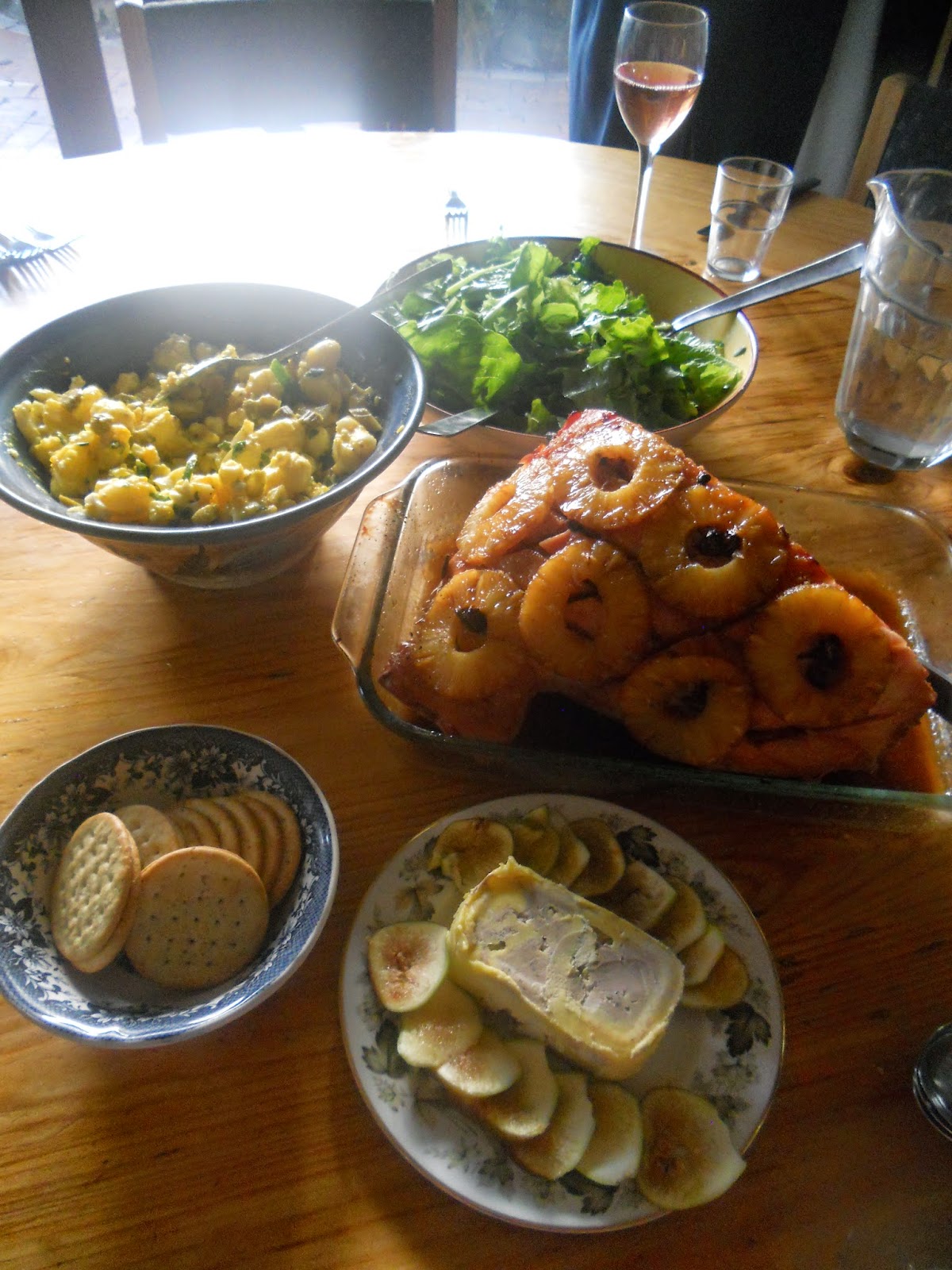
A picture collection of meals over Christmas.
| Christmas Eve--duck foie gras from Victor Hugo markets in Toulouse, ham glazed in pineapple and star anise sauce, potato and egg salad, green salad |
| Christmas Day entree: prawn cocktail with tiger prawns, avocado, shredded lettuce and home-made Mary Rose sauce |
| Christmas Day table |
![]() |
| Christmas log |
| Boxing Day: ham glazed with sour cherry and creme de cassis sauce; home-grown Puy lentil and herb salad; home-grown potato salad; green salad; couscous and pomegranate salad |
| Boxing Day dessert: pavlova |
| Post-Christmas soup: ham stock, home-grown onions and herbs and garlic with a pesto made from chopped cashews, herbs, garlic, chilli |
| Post-Christmas lunch: smoked trout with mustard and sour cream sauce, truffle salami, dolmades, cheeses,home-made pickled plums, home-made brioche, scones, bread rolls |
Tuesday, December 23, 2014
Two yummy festive cakes
![]() |
| Chocolate and cherry cake |
| Frangourou Christmas log |
Two gorgeous and easy cakes for festive celebrations!
The first is a chocolate and cherry cake I've adapted from a Black Forest style, the second an adaptation of the traditional French Christmas log--a cake I make every year for the family Christmas lunch. Both are easy--the log particularly so, as it does not even require any baking--and super delicious of course!
Chocolate and cherry cake
150 g dark cooking chocolate
150 g castor sugar
150 g unsalted butter
3 heaped tablespoons self raising flour, sifted
5 eggs
pinch salt
Melt the chocolate in a pan over low heat(add a little water first to stop it from sticking). Still over low heat, stir in the sugar. When all sugar mixed in, take pan off heat and cut the butter into small pieces. Put pan back on heat and stir in the butter a little at a time. Now slowly add in the flour, stirring constantly, and continue stirring even when mixed in, till it begins to thicken. Take pan off heat. Heat oven to 180 C, and get a round cake tin ready, buttering the bottom and sides and dusting with flour, or using baking paper.
Separate the eggs one by one--put the egg whites in a bowl, but add each egg yolk to the chocolate mix and stir in. When all egg yolks are used up, beat the egg whites till stiff, adding the pinch of salt, and fold into the cake mix. Put mixture into the tin and bake for about 40--45 mins. (Test if cooked by inserting knife into mix after about 40 mins)
Make a coating for the cake of more melted dark chocolate(I actually used Lindt's dark chocolate with orange pieces, delicious!) -You melt the chocolate over low heat with around 25 g of unsalted butter, a tablespoon of full cream and a tablespoon of icing sugar. Coat the cake with it when it's cold, and add halved sweet black cherries as decoration. Serve with whipped cream and/or icecream.
Super easy, super delicious frangourou Christmas Log cake(requires no baking, can be made Christmas Eve).
This was my mother's invention, we had it every Christmas when we were kids, and I still make it every Christmas.
Ingredients:
1 packet sponge finger biscuits
200 g unsalted butter, melted
1 or 2 eggs(depending on how much mixture you have)
half to 3/4 cup hot strong sweet coffee(a good instant coffee works fine)
Cooking chocolate, melted with a little cream.
Crush all the biscuits, add the hot sweet coffee, the melted butter, and mix well. Add the slightly beaten egg(or two). You need to obtain a good stiff mix that you can easily shape into a log. That's what you do then--shape it into a log, and then put it in fridge till it is set. Meanwhile melt the chocolate over a low heat with a little cream, stir till all melted and glossy. Spread over the cake, on the top and sides. Put in fridge to set overnight. You can also decorate the top with angelica leaves, almonds, rose petals, sugar holly, whatever you feel like!
To everyone I wish a wonderful Christmas, Hanukkah, and every other seasonal festivity, and a happy New Year. See you in 2015. A bientôt!
Monday, December 15, 2014
Brillat-Savarin, philosopher of food
Reblogged from an earlier post of mine, for a bit of pre-Christmas reading!
The Philosopher in the Kitchen..Very French-sounding concept, that, isn't it? It's actually the English title of 'La physiologie du gout' (Physiology of taste) by the great French writer on gastronomy, Jean-Anthelme Brillat-Savarin(1755--1826). It's a gorgeous book, full of witty and intriguing anecdotes, stories from his life, sharp observation, funny theorising and precise and amusing aphorisms, and I love it and frequently dip into it.
Born
in Belley, in the Savoy region of France in 1755, Brillat-Savarin
studied law, medicine and chemistry and became a lawyer in his home
town. In 1789 at the outbreak of the Revolution, he was sent as a deputy
to the newly formed National Assembly where he served for a short
while. He later became Mayor of Belley in 1793, but during the Terror
fell foul of Robespierre and his gang and with a price on his head, fled
into Switzerland. One of the loveliest and most characteristic of
stories about him is that when he was fleeing in danger of his life, he
still stopped for lunch at an inn and had an excellent meal, and never
mind the revolutionary soldiers hot on his trail! But to cap it all off,
those very same soldiers also stopped to have a good lunch--proof that
even in a revolution, gastronomy is to be treated with respect in
France!
Later, Brillat-Savarin emigrated to America,
where he spent a few years, earning his living by giving French lessons
and playing the violin in an orchestra(he was also a gifted musician)
but returned to France in 1797, under Napoleon's Directoire, and became a
magistrate, living in peace, honour and gastronomic bliss in Paris for
the rest of his life. He'd often written as a hobby, but was finally
persuaded by his friends to write a book compiling his many
observations, anecdotes and theories on gastronomy. He self-published La
Physiologie du Gout in December 1825, but modestly, did not append his
name to it. The book was an immediate success--and soon 'tout Paris' had
guessed the identity of the author, and Brillat-Savarin was famous. But
he did not long enjoy his fame, dying in February 1826.
His
book has had a long and honoured life in France ever since then, and in
the greatest accolade of all, his name was given to a delicious soft
cheese from Normandy, the Brillat-Savarin, and to a baba-like succulent
yeast cake, the Savarin.
Philosopher in the Kitchen is
most certainly not a standard cookbook--there are only a few
recipes--but it's a great pleasure to read, with a timeless, engaging
appeal. For it is not only about gastronomy as both a science and an
art--but above all as a way of life. Brillat-Savarin was a gourmet, a
raconteur and a bon vivant(funnily apposite, isn't it, how all those
terms have to be rendered in French even in English, as it were!)but he
also truly was a philosopher and his mind ranged widely over many
subjects.
His book does not confine itself to
observations on cooking or food and drink in general--he has chapters on
all sorts of aspects of human life, such as sleep and dreams, and even
including death! His historical and literary erudition is worn very
lightly and though some of his theorising seems quaint now, a lot of it
is still very relevant indeed and has been very influential. He was the
first to suggest a low-carb diet as a way of countering obesity, for
instance. And some of his aphorisms have entered common parlance. For
instance, it was he who coined the famous aphorism, 'Tell me what you
eat and I will tell you what you are.'
But there's lots more worth quoting from in this book, here are a few for your pleasure:
The fate of nations depends on the way they eat.
The discovery of a new dish does more for the happiness of mankind than the discovery of a star.
The Creator, who made man such that he must eat to live, incites him to eat by means of appetite, and rewards him with pleasure.
The
man who invites his friends to his table and fails to give his personal
attention to the meal they are going to eat, is unworthy to have any
friends.
Another gorgeous aphorism which isn't
rendered as such but which I'm paraphrasing from one of his chapters, on
the senses, is this:
There are six senses--sight, hearing, smell, taste; touch--and love.
And
to finish, here's an extract from a fabulous and amusing short chapter
entitled 'Privations' which I think encapsulates some of this book's
enduring charm:
First parents of the human race, whose
gourmandism is historical: you lost all for an apple, what would you
not have done for a truffled turkey? But in the earthly paradise there
were no cooks or confectioners. How I pity you!
Great
kings who laid proud Troy in ruins, your valour will go down from age
to age; but your table was pitiful. reduced to ox-thighs and the backs
of swine, you never knew the charms of fish-stew, nor the bliss of
chicken fricassee. How I pity you!
Aspasia,
Choloe, and all you others whom Grecian chisels made eternal for the
despair of the beauties of today, never did your charming mouths taste
the suavity of rose or vanilla meringue; you scarcely even advanced as
far as gingerbread. How I pity you!
Invincible
paladins, celebrated in the songs of troubadours, when you had smitten
giants hip and thigh, set damsels free and wiped out armies of the foe,
no black-eyed captive maiden brought you sparkling champagne, Madeira
malvoisie, or our great century's liqueurs; you were reduced to ale or
Suresnes wine. How I pity you!
And you too,
gastronomes of 1825, sated already in the midst of plenty, and dreaming
now of novel dishes, you will never know the mysteries science shall
reveal in 1900, mineral esculences perhaps, liqueurs distilled from a
hundred atmospheres; you will never see what travellers as yet unborn
shall bring from that half of the globe which still remains to be
discovered or explored:
How I pity you!
Thursday, December 4, 2014
Trinity celebration 5: Le Gateau Russe
The paperback edition of Trinity: The Koldun Code, is now out, and as the final reposting in this series of Russian-inspired pieces, I'm putting up again the beautiful recipe my husband David devised to recreate the 'Gateau Russe', or Russian Cake, my favourite cake ever, which as you'll see was devised in Southwest France, adapting the recipes of Russian emigres. Recently, a Russian friend told me that in fact this cake was very popular in Russia--but that the story went there that it was first devised in--Kiev! So it is called a Kievski there...or maybe not, these days :)
Here's his recipe for a beautiful 'Davidov' which I think I'll dub his version of the 'Russe'! And it shows that a home cook can indeed pull off a Russe as well as any patissier--all my siblings, who'd tasted the 'real' Russes, agreed that it reproduced exactly the look and texture and flavours we all loved at Dodin's!
Celebration cake: David's beautiful Gateau Russe
Whenever we went back to Biarritz, when I was a kid, and were taken
on one of our favourite outings, to the wonderful Dodin patisserie, I
would always ask for the same cake: a 'Russe', or 'Russian'. This
wonderful cake, made of hazelnut or almond meringue, layered with butter
cream that was either flavoured with coffee or hazelnut, tasted like a
slice of heaven to me, with its combination of breautiful crunchy
meringue and lusciously smooth flavourful butter cream. It's a cake you
only ever find in patisseries in the South of France, and only in the
south-west at that--you never see it in the patisseries of Paris, or
anywhere else in France. So you could get it in Toulouse and Biarritz
but not Marseille, for instance. I didn't know why it was called a
'Russe'. Though I'm not sure who first devised it, I'd
hazard a guess its origin might be in Biarritz, which was full of
Russian exiles after 1917. Dodin's Patisserie has been going since the
19th century and though it lays claim to being the originator of the
famous (and delicious)chocolate cake, the 'Beret Basque'(so-called
because its shape ressembles the famous Basque headgear) it does not
claim to have birthed the Russe, though its examples were always
wonderful. (By the way, if you want to drool over some of Dodin's
beauties, here is their website: http://www.dodin.eu/ )
Anyway
to get back to my Russe, it's something that I not only loved in
childhood but now too. But I always thought I had to wait to get back to
South-west France to indulge in it again. I thought it would be one of
those sorts of cakes that would be too difficult to pull off for a home
cook and so each birthday in Australia, I'd put in a request for my
second-favourite cake, the Gateau Moka. This is also a gorgeous cake--a
Genoise sponge layered with coffee butter cream, and David, my husband,
has made it superlatively well for many years. But a Gateau Moka is not
easy to make too far ahead of time and transport and as my birthday was
going to be in Sydney this year, I knew I'd have to think again. I
remembered seeing the 'Swallow's Nest' cake in the Russian cookbook we
bought in Moscow and thought, how about that, and then started thinking,
that sounds a bit like a 'Russe'--and then David said, well, meringue's
much easier to make ahead of time, why don't I have a go at a Russe? He
made me describe it and started looking up recipes--and then made his
own version which turned out spectacularly well and which proved a huge
hit at the birthday party!Here's his recipe for a beautiful 'Davidov' which I think I'll dub his version of the 'Russe'! And it shows that a home cook can indeed pull off a Russe as well as any patissier--all my siblings, who'd tasted the 'real' Russes, agreed that it reproduced exactly the look and texture and flavours we all loved at Dodin's!
The various bits of the Davidov cake can be
made well ahead of time--several days ahead in fact. If you do that you
need to conserve the meringue in an airtight tin and the coffee butter
cream in the fridge. As the butter cream will harden in the fridge,
you'll need to warm it up slightly when you are assembling the cake, or
you'll break the meringue. This cake will serve up to 15 people. (It did
at the party anyway!)
Ingredients for meringue layers and
individual meringue rosettes for decoration: 10 egg whites, 400 g
castor sugar, 2 tablespoons cornflour, 150 g hazelnut meal. You will
also need, for decoration on last meringue layer, some crushed roasted
hazelnuts.
Method: Beat egg whites till stiff, add sugar
bit by bit, beating well after each addition till you get a beautiful
glossy meringue. Mix cornflour and hazelnut meal together, fold into
meringue mix. On one greased or baking-papered tray, pipe some meringue
rosettes for decoration; on another two or three, the meringue
layers(this one had three layers). Bake in a slow oven(150 C) for an
hour or so, till done(biscuit-coloured and reasonably dry.)
Ingredients
for coffee butter cream: 6 egg yolks, 450 g butter(David used a mixture
of 300 g unsalted, 150 g salted, but you can use just unsalted if you
like), 2/3 cup castor sugar, 1/2 cup hazelnut syrup(or light corn syrup,
or pure maple syrup--David used the hazelnut syrup--Monin from France
which can be used to flavour coffee etc), coffee essence or make your
own as David did with 2 tablespoons instant coffee and two tablespoons
boiling water--it should be a thick gooey mixture--you can also use a
small amount of strong espresso).
Method: Dissolve the
sugar in the syrup in a pan on stove. Take off stove and let cool a
little. Meanwhile beat egg yolks till pale and foamy. Little by little,
mix the warm(but not hot)sweet syrup into the egg mixture. When you have
incorporated it all, cut the butter into small pieces and add to the
mixture, beating in well so butter melts and makes a thick cream(you can
make this in the food processor if you have one.) The cream can now be
used if you are putting together the cake or it can go in fridge till
you put the cake together. (Remember to warm it before use.)
Putting
cake together: Put the first layer of nut meringue on the plate, spread
with some of the butter cake. Layer the next round of meringue, repeat,
till you have used up the meringue layers and most of the butter
cream(but keep some for the top and maybe the sides if you want. On the
last layer, spread the rest of the butter cream, and decorate with the
meringue rosettes and crushed roasted hazelnuts.
Saturday, November 29, 2014
Trinity celebration 4: Zakuski spread for dinner
The fourth of my celebratory repostings in honour of the Russian setting of Trinity: The Koldun Code, is about putting on a fabulous 'zakuski' or aperitif spread, Russian style--but making it dinner!
Zakuski spread for dinner
The other day, I bought this gorgeous book called 'Culinaria Russia', which like the other titles in this series, is not so much a recipe book(though there are recipes) as a marvellous journey through the culinary culture of this richly varied and extraordinary part of the world. For in fact it's not just Russia, ie the Russian Federation, that's covered, but also Ukraine, Georgia, Armenia, and Azerbaijan(not sure what the latter four would think of being lumped in with 'Russia', but never mind!) There's wonderful articles and photos on all sorts of aspects of food, drink, folklore associated with food, festivals, looks at sub-cultures, and lots more. It's fascinating stuff!
But as I said, there's also recipes, and there's also the most mouth-watering pictures of food you can imagine. Four such pictorial spreads are devoted to the Russian tradition of zakuski, which can be usefully compared to the Spanish tradition of tapas, or the Scandinavian one of smorgasbord. Like those ones, it accompanies drink,(usually vodka, in this case) is often presented in small dishes(though it can be in bigger ones) and features both cold and hot dishes. Zakuski can be as simple as olives, gherkins and pickled herring, or as elaborate as you like. Salads also feature strongly; colour and pleasing pattern is important.
So, inspired by those pictures, I put together a bit of a zakuski-style spread for dinner the other day. Not all of it was traditionally Russian, but I was still inspired by the concept, the colours, the patterns. And it all tasted great, was simple and quick to prepare, and elicited many admiring comments, both as to the look and the taste!
This is what I made(see photo):
In foreground to right of photo, a Georgian-inspired chicken dish, with tomatoes, tomato puree, onions, dill, chicken stock, Tokay(supposed to use Madeira, but I didn't have any, so I substituted), lemon juice, sour cream. Added chorizo too as didn't have enough chicken! Basically, you just cut up the chicken and chorizo, brown in a little butter along with chopped onions, then add tomatoes, lemon juice, dill, stock, wine, and tomato puree, cook till done(about half an hour). Sauce should be lovely and thick, don't let it burn
In foreground to left of photo, is a mushroom salad. Slice button mushrooms thinly, toss with salt, pepper, olive oil, lemon juice, dill, chives. Do this at least an hour or so before you eat the salad, as then it absorbs the flavour of the dressing most deliciously.
Behind the chicken dish, on right, in mid-field, is a grated carrot salad decorated with capsicum and sorrel. Vinaigrette for the salad is made with Dijon mustard, white balsamic vinegar and olive oil. To the left of the carrot salad, are smoked salmon rolls on a bed of sorrel: slices of smoked salmon simply stuffed with small gherkins and caper-berries.
Far left in background is the other hot dish, which is a Russian-inspired dish of finely cut lamb slices, sauteed in some oil with onion, then vodka added(not too much), cranberries, finely chopped garlic, caraway, and finally sour cream(and salt and pepper of course). Delicious! To the right of that, is a salt herring salad, made of chopped up salt herring slices(which I'd soaked in water first, and then in lemon juice as otherwise find them too salty), mixed with chopped apple, chopped walnuts, finely chopped fresh garlic, and chopped cucumber. Made a dressing for this out of a little olive oil, a little white wine vinegar, sour cream, dill, and wholegrain mustard, it went perfectly with the flavours. Then to the right of that is a warm (but not hot) salad made of braised scallops cooked in a little butter, a little white wine, with garlic, salt and pepper, decorated with capsicum, tomatoes, etc. To the right of that, just behind the bottle of Russian Standard vodka, a salad of avocado, tomato, olives and capsicum, with a dressing like the carrot salad(yes, I know, not very Russian, the avocado, but never mind, improvisation is the key in zakuski!), and finally, in the far background, a green salad with lettuce right out of the garden and a vinaigrette made of olive oil, Dijon mustard, red wine vinegar, with chives and garlic chives. For dessert we had the remaining half of a delicious strawberry tart David had made the day before.
It was a wonderful feast!
Zakuski spread for dinner
The other day, I bought this gorgeous book called 'Culinaria Russia', which like the other titles in this series, is not so much a recipe book(though there are recipes) as a marvellous journey through the culinary culture of this richly varied and extraordinary part of the world. For in fact it's not just Russia, ie the Russian Federation, that's covered, but also Ukraine, Georgia, Armenia, and Azerbaijan(not sure what the latter four would think of being lumped in with 'Russia', but never mind!) There's wonderful articles and photos on all sorts of aspects of food, drink, folklore associated with food, festivals, looks at sub-cultures, and lots more. It's fascinating stuff!
But as I said, there's also recipes, and there's also the most mouth-watering pictures of food you can imagine. Four such pictorial spreads are devoted to the Russian tradition of zakuski, which can be usefully compared to the Spanish tradition of tapas, or the Scandinavian one of smorgasbord. Like those ones, it accompanies drink,(usually vodka, in this case) is often presented in small dishes(though it can be in bigger ones) and features both cold and hot dishes. Zakuski can be as simple as olives, gherkins and pickled herring, or as elaborate as you like. Salads also feature strongly; colour and pleasing pattern is important.
So, inspired by those pictures, I put together a bit of a zakuski-style spread for dinner the other day. Not all of it was traditionally Russian, but I was still inspired by the concept, the colours, the patterns. And it all tasted great, was simple and quick to prepare, and elicited many admiring comments, both as to the look and the taste!
This is what I made(see photo):
In foreground to right of photo, a Georgian-inspired chicken dish, with tomatoes, tomato puree, onions, dill, chicken stock, Tokay(supposed to use Madeira, but I didn't have any, so I substituted), lemon juice, sour cream. Added chorizo too as didn't have enough chicken! Basically, you just cut up the chicken and chorizo, brown in a little butter along with chopped onions, then add tomatoes, lemon juice, dill, stock, wine, and tomato puree, cook till done(about half an hour). Sauce should be lovely and thick, don't let it burn
In foreground to left of photo, is a mushroom salad. Slice button mushrooms thinly, toss with salt, pepper, olive oil, lemon juice, dill, chives. Do this at least an hour or so before you eat the salad, as then it absorbs the flavour of the dressing most deliciously.
Behind the chicken dish, on right, in mid-field, is a grated carrot salad decorated with capsicum and sorrel. Vinaigrette for the salad is made with Dijon mustard, white balsamic vinegar and olive oil. To the left of the carrot salad, are smoked salmon rolls on a bed of sorrel: slices of smoked salmon simply stuffed with small gherkins and caper-berries.
Far left in background is the other hot dish, which is a Russian-inspired dish of finely cut lamb slices, sauteed in some oil with onion, then vodka added(not too much), cranberries, finely chopped garlic, caraway, and finally sour cream(and salt and pepper of course). Delicious! To the right of that, is a salt herring salad, made of chopped up salt herring slices(which I'd soaked in water first, and then in lemon juice as otherwise find them too salty), mixed with chopped apple, chopped walnuts, finely chopped fresh garlic, and chopped cucumber. Made a dressing for this out of a little olive oil, a little white wine vinegar, sour cream, dill, and wholegrain mustard, it went perfectly with the flavours. Then to the right of that is a warm (but not hot) salad made of braised scallops cooked in a little butter, a little white wine, with garlic, salt and pepper, decorated with capsicum, tomatoes, etc. To the right of that, just behind the bottle of Russian Standard vodka, a salad of avocado, tomato, olives and capsicum, with a dressing like the carrot salad(yes, I know, not very Russian, the avocado, but never mind, improvisation is the key in zakuski!), and finally, in the far background, a green salad with lettuce right out of the garden and a vinaigrette made of olive oil, Dijon mustard, red wine vinegar, with chives and garlic chives. For dessert we had the remaining half of a delicious strawberry tart David had made the day before.
It was a wonderful feast!
Subscribe to:
Posts (Atom)