Thursday, October 1, 2015

Enter the asparagus


As it's asparagus season again, I thought I'd repost some previous recipes featuring this most delicious of vegetables, in three lovely entrees!  
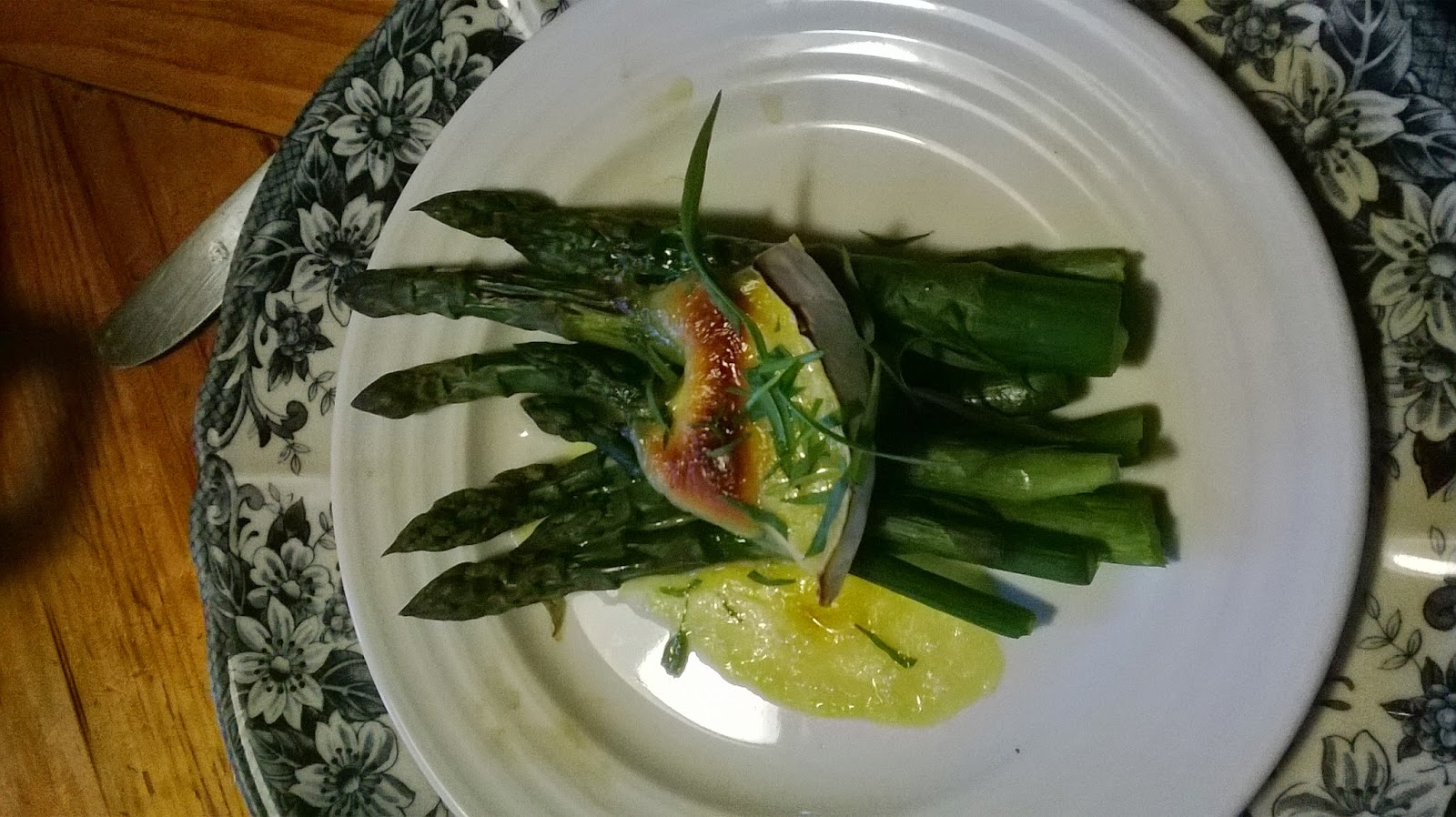
From early September on to the end of October, asparagus finds its way frequently onto our entrĂ©e plates. Steamed or braised, cold or warm, they always make a fabulous starter. Here are three simple and delicious ways to serve them: steamed, with a vinaigrette made from virgin olive oil, white balsamic vinegar and Dijon mustard;  lightly braised in olive oil, with a slice of melted Brie on top; and  fresh steamed asparagus with semi-hard-boiled egg dressing. Steam the asparagus till cooked but not too soft, let them cool. Boil an egg(not too hard-boiled but not soft-boiled either), peel off shell, then chop the egg into bits. In a small bowl mix a tablespoon sour cream, a teaspoon Dijon mustard, a little salt, pepper, a small splash of either lemon or white balsamic vinegar. Mix the chopped egg in with this and serve the mixture drizzled over the asparagus.
Other delicious ways to serve include: the basic braised one with cooked small cherry chopped tomatoes and olives scattered on top--other toppings for cold entree asparagus include chopped smoked salmon or very good leg ham; and for the warm variety, sesame oil can replace the olive oil, and chopped stir-fried prawns with coriander and Vietnamese mint scattered on top. In fact, the only limit is your imagination, when you start with that basic delightful green handful of aspragus spears!

Saturday, September 26, 2015

Alexis doing his magic in Paris

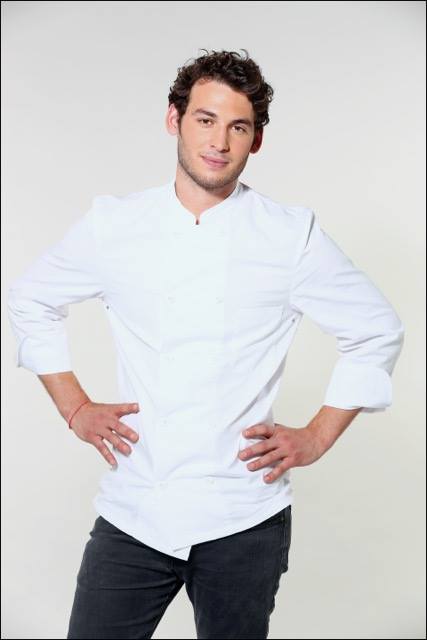
My nephew Alexis Braconnier is a fabulous young chef who has already made his mark in the French TV program Top Chef as well as in hotels and restaurauts across the country. Alexis is featuring this weekend in Paris in a foodie event called 'Les Heureuses Heures de la Tartine', (The Happy Hours of the Open Sandwich, basically!) which is being held in 25 restaurants across the 14th arrondissement. Alexis will be working on the Sunday.
If you're in Paris, check it out! 
You can learn more about Alexis and his wonderful recipes at his Facebook page.

Friday, August 28, 2015

A Basque flavour 2: David's Gateau Basque

David's recipe for a simple and delicious Gateau Basque:


Ingredients for pastry: 200g plain flour, 1 whole egg plus 1 egg yolk, 130 g castor sugar, 130 g unsalted butter, pinch salt, lemon rind. Ingredients for custard: 200 ml milk, 1 egg yolk, 50 g castor sugar, 20 g plain flour, a little cherry brandy(optional), some stoned Morello cherries(he used our own homegrown ones which had been preserved in armagnac but tinned Morellos could conceivably be used). First make the pastry: put the flour in a bowl, make a well in it and into it put the egg yolk, the lightly beaten whole egg , the sugar, pinch salt, and the softened butter. Mix carefully till well combined and forming a good smooth and not sticky pastry. Put it in the fridge to rest while you prepare the custard. Dilute the flour with a little of the milk. Warm the rest of the milk gently. Beat the egg yolk with the sugar, then add to warmed milk, and then add the flour mixture, stir over stove till nice and thick(and do not let it boil.) Off the stove, add a little cherry brandy, and then the cherries. If you want to make the classic custard-filled Gateau Basque, omit both the cherries and cherry brandy. You can also flavour your custard with rum if you like.

Grease a cake or tart tin, roll out the pastry, make a base and sides out of most of it, then pour the custard mixture into it. Make a lid with est of the pastry, crimp the edges well together, then glaze the top with a pastry brush dipped into some egg yolk. Score the pastry with a knife to form a pattern(rather like that on Pithiviers pie.) Bake in a moderate oven for about half an hour. The cake is delicious both warm and cold.

Monday, August 24, 2015

A Basque flavour 1: Poulet Basquaise

We spent quite a while in the Pays Basque these holidays, revisiting the ancestral home of my mother's family and reconnecting with many of my aunts, uncles and cousins there. And eating lovely Basque food of course!
The cornerstones of savoury Basque cuisine are red and green capsicums/bell peppers, as well as the long 'sweet peppers'; tomatoes; onions and garlic; and of course the lovely chilli powder known as 'piment d'Espelette', which is made from the long peppers grown there and which has a lovely sweet yet spicy flavour--something in between paprika and hot chilli. Added to dishes during cooking, it really gives a great spicy tingle; sprinkled on afterwards, you get the fruity flavour but it's less 'hot'. Whatever, it's used on everything there--eggs, meat, fish, even occasionally sweets! You can order it in Australia, here and here for instance, but if you can't find it, you can try substituting a hot paprika(not quite as good, as paprika is ground much finer than piment d'Espelette--the latter is quite coarse, which gives it more flavour. )
I'm posting on this blog a couple of recipes that are absolute Basque classics and quite easy to make. This one is for Poulet basquaise , or Basque-style chicken, and in the next one I will republish David's great recipe for a simple Gateau Basque, THE Basque cake par excellence!

Poulet basquaise

Ingredients: (for 4 people)
1 kg chicken pieces, diced--or a whole chicken, cut into pieces
4 good truss tomatoes(or use a can of tomatoes)
1 large onion
2 capsicums--1 green, 1 red
2 cloves garlic
1 bay leaf, pinch thyme, parsley
salt
piment d' Espelette powder --or if you don't have any, a hot paprika powder can substitute
salt and pepper to taste
olive oil for frying

Chop the onion and fry it and the crushed garlic in the olive oil. Separately, saute the chicken pieces in some more olive oil, and salt and pepper to taste(don't add too much pepper, as the piment/paprika powder will be added later) . 
Add the chopped capsicums to the onion and garlic mix, sit well, then add the herbs, and stir a little more. Now add the tomatoes, and cook till the sauce is nice and thick.
Add the sauce to the cooked chicken pieces, sprinkle in some paprika/piment powder, and simmer for about half an hour, till the chicken is completely cooked through. If the saice starts sticking, add a little water, just enough to deglaze the bottom.
Serve with extra chopped parsley and paprika/piment powder on top. Goes well with rice.

Wednesday, August 19, 2015

Easy yoghurt

The yoghurt in process of setting.
We have made our own yoghurt for years and it's excellent, much cheaper than the store-bought variety, and very easy to make. And you need no special equipment. I've been asked to put up the recipe(which is David's invention!)so here it is. We only ever use full cream milk for it as it's such a much better taste; you can experiment with skim but it doesn't set as well, I believe.

David's yoghurt

Ingredients: 1 litre UHT full cream milk, 3 spoonfuls powdered full cream milk, 1 spoonful live yoghurt culture(we use Greek-style yogurt--must be full cream milk yoghurt). Once you have made this once, you just keep back one spoonful from your own yoghurt to make the next batch.

Mix the UHT milk, powdered milk and spoonful of yogurt till well-combined. Heat the mixture to blood temperature(ie the temp of a baby's bottle). Pour into lidded icecream container or similar, and keep at a constant temperature--either in a foam esky or in the linen cupboard or similar.It needs to sit a few hours like that. If you make this in the morning you can then, at end of day, take it out of wherever it's been sitting, and put it in fridge. The next morning, it'll be set and ready to eat!

Monday, July 27, 2015

Visit to a goat farm in southern France


I am back in my sister's home region of the Aude in southern France and last night had some excellent goat cheeses made by a local producer, Xavier Tissot; Two years ago, when we were here, we went to his farm open day, which was very interesting, so today I thought I would republish the article I wrote then about it!

Visit to a local goat farm
We had a very interesting afternoon the other day visiting a local farm, Bourdichou, which specialises in one hundred percent organic goat cheese produced using traditional methods with goats fed entirely off the organic feed produced on the farm itself. Lucky goats--they get not only the usual kind of feed of barley, grass and sainfoin(a coarse hay type feed) but also high quality green lentils produced on the farm, of the Puy variety, of which the farm produces about 6 tonnes. (The lentils are also sold to humans and are delicious!)
As well as buying some excellent cheese and having a bit of a tour of the 30-strong goat herd, who were all very bright-eyed and bushy tailed and very friendly as they are handled a lot, we were also treated to a very interesting free 45 minute slide presentation by owner Xavier Tissot, who explained everything about the farm, how it's run, what crops are grown, what the programme of each day is, etc. This is an added bonus of a visit to the farm to buy cheese--call ahead of time and you can also assist at one of these presentations(best done in a group or family). By the way they have an excellent  and informative website with all contact details and info on how to get there, http://www.aude-chevrerie.com/
The Bourdichou farm is situated in gorgeous rolling countryside in the Aude region, and consists of 102 hectares, supporting 30 high-yielding goats in constant milking. From those 30 goats, milked twice a day, the Tissots get 22,500 litres of milk per year, which converts into 34,700 cheeses a year, or around 120 a day. From the milk, the Tissots make only cheese, in different varieties: plain, flavoured with onions or rosemary, or oregano or thyme or lavender, and also rolled in pepper. (They also sell honey from their own hives as well as lentils). It's plain to see the goats are thriving; they are all extremely healthy, bright and curious and very productive. They also each have a name, as they are very much a part of the family and Xavier Tissot speaks of them with great affection and humour--one funny observation he made was, 'Goats are rather like adolescents; they can veer from endearing to very annoying in record time!' The goats are out in the fields grazing half the day (where they have to be watched)and half the day in their comfortable shed where they are given their hay, grain and lentils.
Of course it's a huge amount of work for the family for it is a never ending cycle. Market days are particularly heavy for the milking has to start at 4.30 am and does not finish till 7pm! Days where markets aren't happening are slightly less heavy--they get an extra hour's sleep and don't have to get up till 5.30 am! Then of course there is the crop work, which they do get outside help with, but still do most of it themselves.
The Tissots only do direct sales--from the farm gate, at local markets where they go several days a week, at special fairs and gastronomic events and occasionally from people who have been to the farm before ordering over the phone or online. They don't sell to restaurants, and most of their sales  are at markets. But if you are travelling in the region, I would urge you to go and visit the farm directly, for not only do you get the chance to buy the products at the very spot where they are made, but you also get an absorbing insight into how the life of a farm.
And the cheese? We bought a platter of it, about six or seven cheeses, in different varieties and it was all absolutely delightful, fresh, tasty and very very more-ish, with the platter being demolished very rapidly. And it was only 10 euros for the whole lot--an absolute steal! Highly recommended.

Thursday, June 11, 2015

Pippa's delicious salmon gravlax revisited

Today I thought I'd republish my daughter Pippa's recipe for a spectacular salmon gravlax, which I first published on this blog back in 2011. She'd made it for Christmas--but it's something that can be enjoyed at any time of the year, for any special occasion!


Cured in salt, sugar, fresh grated beetroot and orange juice, it looks and tastes fantastic, and is prepared in minutes(though you need to leave it for 24 hours to cure before serving).

Here's her recipe, with quantities suitable for a half-side of fresh salmon, skin off.  (Just modify quantities depending on how much salmon you have)


You need three grated beetroots and 3 juiced and zested oranges. Mix together with some sprigs of dill and pop it in a long china or glass dish big enough to hold the salmon. Then mix 100 g of sea salt(coarse)and 3/4 caster(fine) sugar and coat fish in it, pressing it in on both sides. Then put salmon on top of beet/orange mixture, cover with plastic wrap and keep in the fridge for 24 hours. The next day, take it out, wipe off any excess salt/sugar with a cloth , take the salmon out of the dish and slice it thinly to serve. Serve it with sliced Spanish onions, thinly sliced cucumber, and a cream cheese and caper mix on the side.